Samuel Cooper is a Wellington-based solo pianist who specialises in tailoring live music for
weddings, corporate events, and private functions. With a repertoire spanning classic hits
from the 1950s through to today’s favourites, alongside jazz, blues, and original works, he
creates elegant and memorable soundscapes that elevate any occasion. Samuel has
performed across Wellington’s hospitality and live music scene, including the Wellington
GOLD Awards, Academy of Fine Arts exhibition openings, and regular residencies at local
hotels (James Cook Hotel, IBIS Hotel) and venues. He takes pride in always reading the room
to deliver the right atmosphere and soundtrack for his audience.
Alongside his work as a performer, Samuel is also an accomplished composer of
contemporary classical piano. Since beginning to write in 2017, he has released two albums
of original compositions, drawing inspiration from personal experiences, resilience, and
themes of mental health awareness. His cinematic style blends emotional depth with
melodic clarity, resonating with listeners while carrying strong potential for placement in
film, television, and other creative projects. As both a performer and composer, Samuel’s
goal is to uplift, inspire, and leave a lasting impression through the power of the piano.
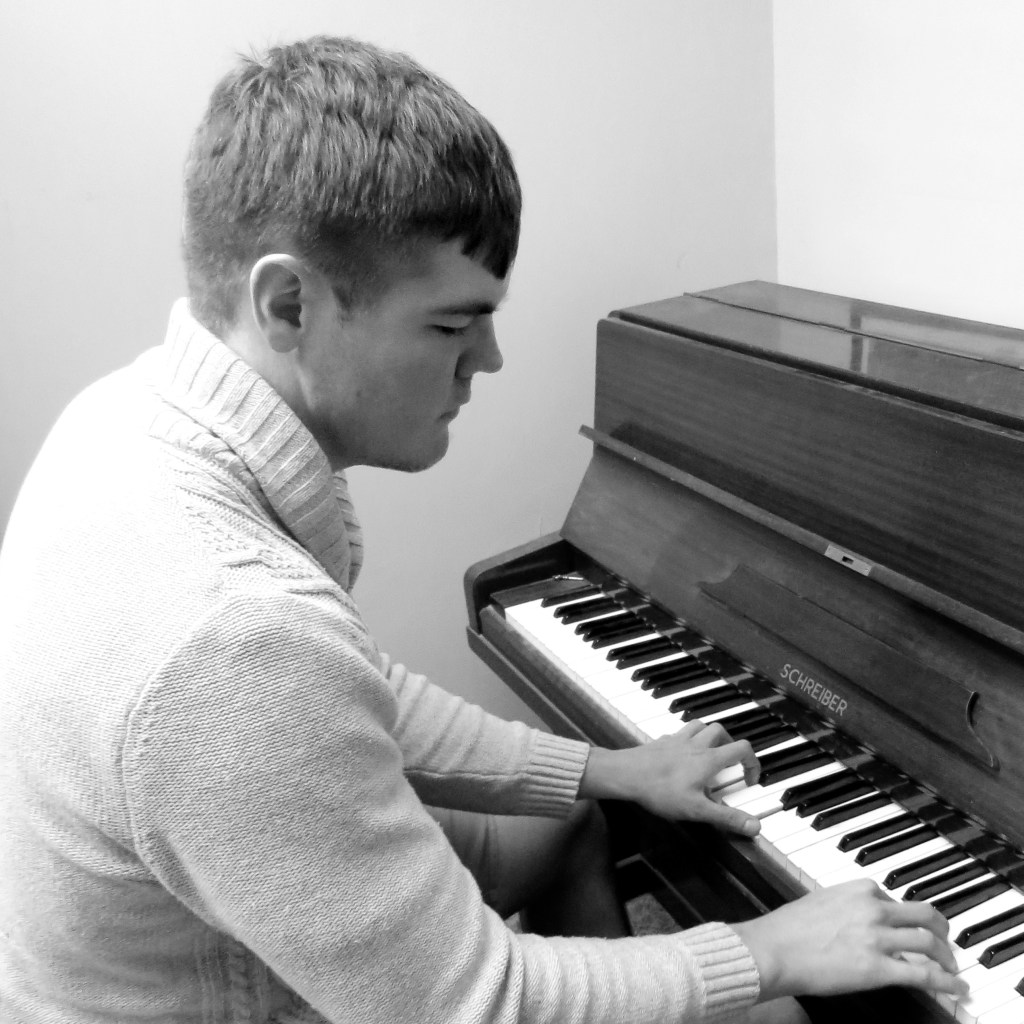
A more detailed insight into my piano journey…
For as long as I can remember, a piano has always been present in my life. I grew up with a piano in the hallway of my family home, as well as at my grandparents’ place. My earliest memory of playing the piano was learning by ear at around 5 years’ old, playing the New Zealand national anthem as I always watched the All Blacks rugby matches with my Dad and I loved seeing and hearing the passion of the crowds when the anthems were played. (My early anthem repertoire increased around Rugby World Cup time in 2003 when I learnt other countries’ anthems, too.) Seeing my interest, my parents signed me up for keyboard lessons at primary school followed by two years of piano lessons at intermediate. For Christmas 2002 I was given a Casio keyboard which I used to practise on, together with our home piano. Lessons taught me the basics of how to play but I struggled reading music and having to have my fingers in the correct place – but was firmly told ‘they were the rules’! I preferred playing songs that I liked listening to, rather than playing songs (many unknown to me) from the music books and doing theory exercises. That largely remains the same today, although I must confess that in recent years I’ve enjoyed learning various aspects of theory which have helped me develop as a pianist.


Back then, it was clear that pursuing formal piano lessons and having to learn via theory and reading musical notes was not for me and I quit in 2008. From then on I played and learnt by ear and watching YouTube tutorials.
There was a talented pianist called Fletcher Mills at my intermediate and high schools who played several amazing piano covers, including Coldplay songs and the intro to OutKast’s song ‘Roses’ which I found incredible (and still do as I have tried learning the latter recently, and found it extremely difficult). Seeing Fletcher play the piano so well gave me huge motivation to play pop covers the way he could. I loved listening to music, so it was both appealing and satisfying to able to learn and play my favourite songs. With online music tutorials and piano covers on YouTube, I was able to learn ‘my way’ – when I wanted, however long I wanted, and with whatever fingering that was easiest for me.
During my high school years at Wellington College there were several pianos which could be used if they weren’t booked or requested by music students. I occasionally played these before classes and at lunchtimes. During this time, playing the piano was something extra when I had time, as I was passionate about my sport, cricket and basketball in particular, and spent many hours hitting balls or shooting hoops! I only played the piano when motivated to learn a song that I really liked, and went on YouTube and listened to a song over and over in order to learn it. Little did I know that by learning and practising songs I liked in this way, it enabled me to become familiar with the musical ‘keys’ and chord progressions that songs were structured with.
Towards the end of my high school years I tried to learn more challenging songs. I learnt tricky left hand arpeggios needed for more complex songs. I recall learning songs such ‘Invincible’ by Tinie Tempah, ‘Fix You’ by Coldplay and ‘Wake me up’ by Avicii, and this gave me confidence, fulfilment and self-belief in my ability to play. Friends listening to me playing the piano would often give me requests which I would then learn. Music subjects at school never interested me simply because of the theory and music reading element that was required.
Another technological advance that helped me to learn by ear was the iPod. I got my first iPod in 2012, and could listen to music whenever and wherever I was. Repetitive listening to songs on the iPod enabled me to play parts of songs by remembering how it went. With earphones on, I would sit by my Casio keyboard and ‘trial and error’ the notes and chords of a song until I got it right. This was incredibly difficult to begin with and I often defaulted to YouTube’s tutorials, but I persisted and gradually got better and better at it. This is the very process I still use today when learning a cover of a song I like.
I decided to study environmental policy and planning at Lincoln University in Christchurch, and in 2014 my studies commenced. Of course, my keyboard accompanied me to university and was set up in my room. I continued to learn new songs, greatly assisted by Spotify and the delight of having any song immediately available to discover and listen to. A pivotal moment in my music came in my Hall during my first year at Lincoln. A fellow student gave me a contemporary solo piano tune to learn. It was called ‘At the Ivy Gate’ by Brian Crain. I thought the tune was absolutely beautiful, and despite being very difficult at first, I pursued the challenge, learnt it, and discovered a love for classical, and solo piano, music – the polar opposite of what I liked when I first started playing. I found the contemporary piano genre to be incredibly soothing and easy to listen to. Spotify’s discovery functions enabled me to discover artists similar to Brian and I found my next influencer, Michele McLaughlin. I connected with both Brian and Michele’s music so well and listened rigorously to their albums as I wrote my university essays and assignments. Some of my favourite songs of Michele’s were ‘When you were still around’, ‘Across the Burren’ and ‘A Celtic Dream’. Brian’s songs included (as well as the one introduced to me) ‘Butterfly Waltz’, ‘Song for Sienna’ and his rendition of ‘Hallelujah’ by Leonard Cohen. I continued to learn other songs from artists such as Kygo, Avicii – just about any top pop song that I liked or people recommended to me. I began posting covers to Facebook and these seemed to be well received by my friends.
2015 was another important year in my piano journey. I discovered a grand piano on Lincoln University’s campus and fell in love with the sound of this beautiful instrument. Almost every day I would play this grand piano and I posted many pop, and some classical, covers for my friends on Facebook. My faithful old Casio keyboard in my room was still useful and great for learning on, but I played and played on the grand piano because it sounded so incredibly beautiful. I played late into many nights – often nights that I was meant to be studying! By playing songs I liked over and over, I continually challenged myself and gradually improved. One of my biggest accomplishments was smashing the immensely challenging ‘Bohemian Rhapsody’ by Queen.
In 2017, things started to go a little bit haywire in my life. I had a complex and emotional break up with my girlfriend. I have memories of walking along Evans Bay in Wellington after we broke up, where I sat and cried, looking at the lights of the Hutt motorway and Petone in the distance. I have attempted to encapsulate this image in the cover art of my first single ‘Broken Heart Recovery’. The ensuing heartbreak and sadness led on to depression and something I had never experienced before. Up until that point in my life, I had always tried to hide things so as not to dampen people’s moods. I had experienced occasional bullying at intermediate and high school, but the deep emotional feelings of heartbreak were extremely difficult to deal with. I was suffering silently as I didn’t want people to know I couldn’t cope and was struggling mentally. As my mental health declined I turned to the piano as a welcome escape from my feelings. I started improvising songs that expressed my depressed, yet at times hopeful, feelings. This experience helped me to reach out to those close to me and talk about the mental pain I was in.
Continuing to structure those improvisations quite instinctively, I thought, ‘this isn’t sounding too bad, I’d love to structure and record these improvisations like Michele and Brian’. So I got my phone out and recorded my improvisation, one turned into two, and two turned into many. It was during those nights that I improvised my feelings about my break up, and that improvisation would later be the structure of my first release ‘Broken Heart Recovery’, and album ‘Breaking the Silence’. I had listened to many contemporary classical albums and learnt and studied the arpeggios that my influencers used – and I got creative! I would record, listen back, delete and write down parts of recordings. I kept all of these improvisations and they formed the basis of composition ideas and structures for new songs which I began in 2018.
It was during 2018 that I posted to YouTube and Facebook my first properly completed composition ‘Fighting Through The Storm’. My friends on Instagram and Facebook really liked it, and that encouraged me to keep working on more original pieces from those improvisations from the previous year. Eleven more compositions followed over the next two years, all focussing on mental health awareness and the message that – ‘it’s never weak to speak up’. This is a subject I began to read and care about after I recovered from some of my own struggles and became a lot happier. I paid more attention to the suicide statistics and what a big problem it is in New Zealand, particularly for young people and men in general. My aim in posting my compositions to Facebook and Instagram was (and still is) to write a bit of my backstory in the song and the melody, making myself a little vulnerable. I did, and still do this in the hope that my music and posts reaching anyone connected with me on Facebook and Instagram who may be going through a hard time, will see my message and may then be able to find the strength and courage to speak to somebody about their mental health and get help to get better, instead of silently suffering or taking their life. This remains my primary driver and vision with my piano career to date, particularly with my first album ‘Breaking the Silence’. I want to raise money and awareness for mental health and help do my bit to create an environment where people feel comfortable to talk about their feelings and struggles and not feel ashamed or embarrassed, as I did, to take that first step.
Throughout 2018 and 2019 I continued to develop these compositions, posting them on Facebook and Instagram, and people kept giving me positive feedback. In 2018 I did a couple of notable performances – one at the City Gallery Wellington on Michael Parekowhai’s 2011 piano artwork ‘He Kōrero Pūrākau mō te Awanui o te Motu: Story of a New Zealand River’ and another at the Petone Working Men’s Club. I can never resist playing on public pianos, particularly Wellington waterfront’s piano. The piano in the Lower Hutt City Council buildings where I worked for a while was a welcome lunch break for me, and also for passers’ by who would stop to listen.
In May 2019 I made the decision to take the big step and find a studio to record my compositions. I practised relentlessly on all 12 compositions and other improvisations I had saved from ideas I’d had in late 2017 at Lincoln. I hadn’t had the time to structure these improvisations into complete songs – I just knew the ideas, the progressions and the meanings. I got into the recording studio at Massey University in December 2019 and recorded 18 songs, all of which I’m very proud of. Following the recording, I have gone through various processes to try and get my music onto Spotify and other music streaming platforms and to think about my imminent single and album release.
Not long after the recording of ‘Breaking The Silence’, the dreaded COVID 19 pandemic arrived. While incredibly difficult for many others around the world, it gave me extra time to work tirelessly on my piano playing in many areas. This included building up my repertoire of old classic rock and pop songs, and practicing with the intention of performing live when the pandemic ended. It also gave me time to go through the process of getting my studio recordings/masters onto the music platforms and launching my piano brand/release.
The journey from recording my compositions in the studio to getting it onto the music platforms was a considerably time-consuming process. This involved registering the work (on APRA AMCOS NZ and Recorded Music NZ) to decide on the most suitable digital distributor (Distrokid) to use for my uploading, and then claiming my Spotify for Artists profile. With the release, I decided to put the album on a physical CD! This involved designing a CD case that could include explanations on what each composition was about. Several of these processes were particularly difficult to navigate through, but I got there in the end with the help of some amazing and kind friends who I am very thankful for. In particular, Beppo Wallace (Dink Design) and William Donaldson who both worked on the CD case design (William has also been instrumental with my website design too). Also during this process, I was fortunate to have Ani-Oriwa Adds at the Whakaaro factory design my piano beautiful branding logo. The release of Breaking The Silence in December 2020 was a success. Through physical CD album sales, and a Givealittle fundraiser, over $2,500 was raised for the Voices of Hope Mental Health charity which was well beyond my expectations. Below is an extract of Kev Rowland’s review from MuzicNet:
“He has a wonderful touch which enables him to provide simple repeated melodies which makes me feel like I am listening to the sonic version of a babbling stream passing through the forest, the dappled light shining on its surface as it gently flows over the stones in the river bed.”

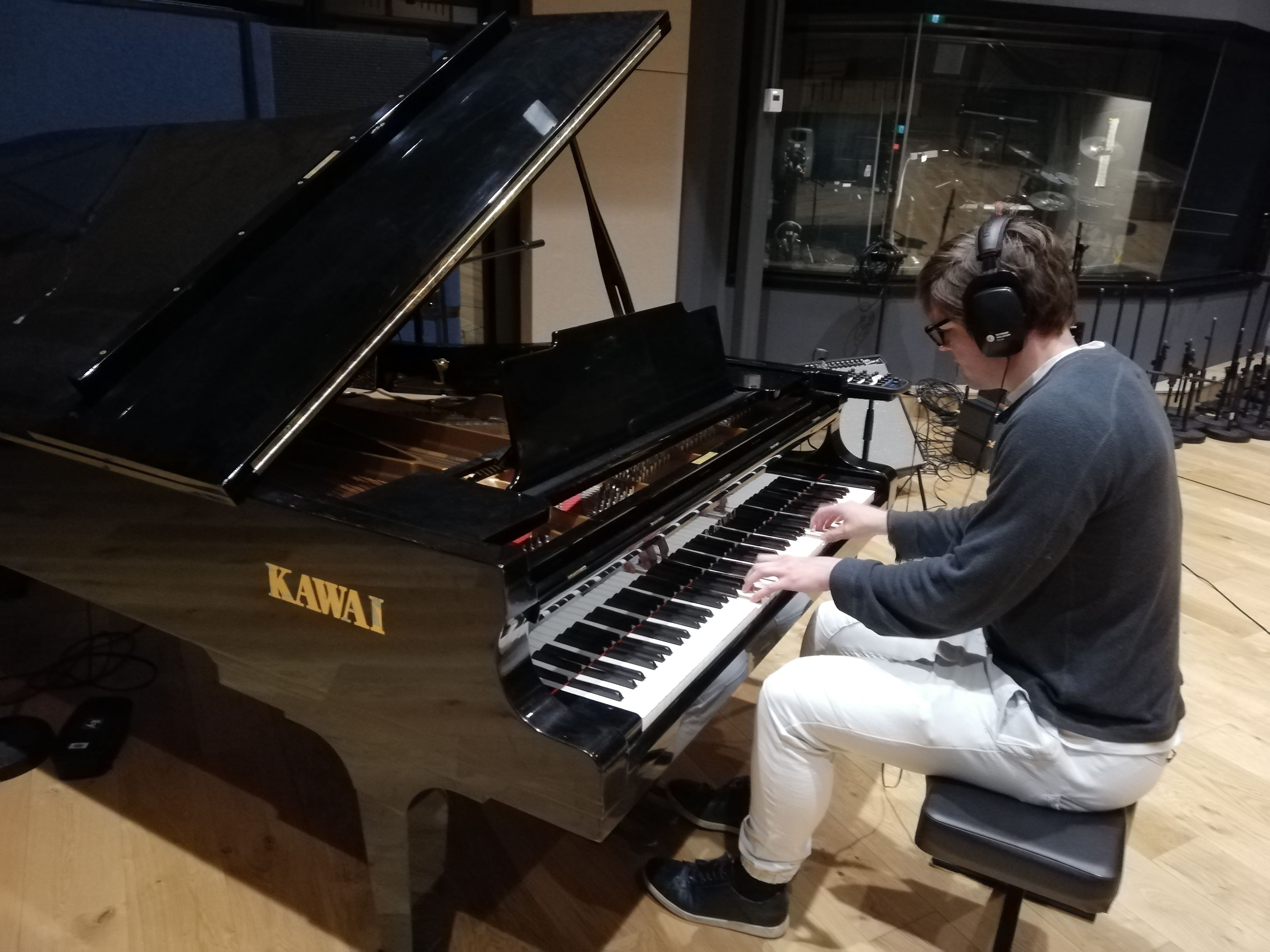
By March 2022, the COVID 19 Pandemic had ended, and I was determined to get out of my comfort zone and perform live. I’d had some experience of performing live at my cricket club clubrooms – I was lucky because it was a safe and supportive environment’. Doing several of these enabled me to gradually build up my confidence and get a feel for what performing took, opposed to mostly playing in my bedroom. I had my first proper performance of my compositions at the Goethe-Institut in March 2022. Despite being incredibly nervous, the performance went well and gave me a lot of self-belief that I ‘could’ successfully perform live. Fortunately, this performance led to several other performance opportunities.
These performance opportunities have included playing private gigs at the Wellington GOLD awards, and at CIRCA Theatre where I’ve played old classic rock and pop items that I practiced incredibly hard on during the COVID lockdowns. Further in 2022 following these initial performances, I had the pleasure of performing at the ‘Let’s Get Comfy about talking about Mental Health’ event, as well as a trip back down to Lincoln University to perform an hour long concert for Mental Health Awareness Week. This was particularly special because I performed in the same space and piano where I first composed the very songs that are on Breaking the Silence – when I was in a dark space. You can view some footage from this concert in the videos section of my website.
One of my most exciting musical moments came on the 12th May 2023. The incredibly talented singer-songwriter Cassie Henderson, invited me to perform a piano accompaniment of her beautiful song, ‘Tainted’, with her on stage at her show at the St James Theatre in front of a strong crowd. As I got the call only a few days before the show, I had to learn the song quickly and write a piano accompanying version. The performance went well, and was a very thrilling moment. A video of this performance can be viewed in the videos section of my website.
In 2023, I released my second studio album, ‘Journey To Sobriety’. Since turning 18, I regularly drank alcohol most weekends to the excess. By the age of 22, it was becoming a problem in my life, and was something I actively wanted to reduce and tone down. By the age of 25, I found it near impossible to moderate my drinking. My poor decisions while drinking and vicious hangovers resulted in a great deal of shame, great anxiety, negatively impacting mental health as well as an inability to make as much progress on my music. In November 2021, a day after a big afternoon of drinking and an embarrassing episode, I decided that I was never drinking again (that’s what I always said..). But that day morning, I meant it, and to this day I remain sober and determined to remain sober for the rest of my life. The first part of the album reflects my internal feelings of my drinking being out of control, the determination to quit but despite every best intention to stop, falling back into it and making mistake after mistake. The second part reflects the more positive feelings and benefits/relief of being sober, but also the challenges of dealing with temptations that will always come and go along my journey.
From 2021 to 2024, I unfortunately suffered several concussions, followed by significant
setbacks/sub-concussive hits. This led to many long periods of being unable to play or
perform my music. It was a very difficult time for me, and I found it a hard pill to swallow.
Sometimes I couldn’t resist the temptation to play, which would then cause further setbacks
and subsequent frustration and anger for me. Through both enduring and recovering from
these experiences, it allowed me to write several new melodies and compositions that
reflected that frustration, but also a lot of acceptance of living and recovering from
concussion. These compositions will form part of a new album/project that I will be
intending to release in the summer of 2025/26. With it, I am intending on creating as much awareness about the seriousness and incredible mental challenges involved with
concussion.
During 2024, I completed my OE to Europe where I travelled there for 3 and a half months.
It was an incredible journey and had I several impressions and I did improvise on public
pianos. While my concussion album project will be my focus for 2025, I will be structuring
some of these particular Europe-inspired compositions which will very likely to be the focus
of my 4th album! Arriving back to New Zealand in late 2024 after my OE, I decided to take a
voluntary redundancy from my day job to focus on my music on a full time basis. Over the
years, I had found it difficult to working an intense 9-5 policy job 5 days a week and being
able to take my music to a new level/perform regularly without burning myself out. I am in
the process of reaching out to bars, restaurants, retirement homes etc. to be able to make
doing my music full time or semi full time financially viable. This is my focus in 2025, and I
am excited at where I can take it!!
Thank you very much for reading my piano story and taking an interest, and I hope to see you at one of my shows in the future. In the meantime, more of my story can be found in my music!
 Solo Piano | Samuel Philip Cooper Pianist